Where Tech Commuters Actually Live on the Eastside: Drive Times, Light Rail and Price Points
If you work at Microsoft in Redmond, Amazon in Bellevue, or Google in Kirkland, the first housing question usually isn't "which house?" It's "how long will the drive be?" Since the 2 Line light rail finished its run across Lake Washington on March 28, 2026, that question has more than one answer. In this post I'll walk through typical drive and transit times, how the light rail fits in, and where prices and housing types land by area. I'm keeping this about commute, cost, housing type and amenities, because that's what you can actually measure.
First, where the big employers sit
Three clusters come up most often. Microsoft's headquarters is in Redmond, and the Redmond Technology light rail station sits on land Microsoft donated from its campus (GeekWire, March 2026). Amazon told reporters at the line's opening that it employs about 15,000 corporate workers in Bellevue, mostly downtown. Google's Washington offices include its South Kirkland campus and the newer Kirkland Urban buildings in downtown Kirkland, according to KUOW's 2022 reporting; I couldn't find a more recent headcount, so I won't quote one.
That gives you three anchor points: Redmond, downtown Bellevue and Kirkland. The rest of this post is about how far everything else is from them.
Typical drive times (peak hours)
These are peak-hour estimates from RexMont's Eastside commute guide (published May 2026). They are ranges, not promises, and a single accident on SR 520 or I-405 can blow past them:
- Redmond to the Microsoft campus: about 5 to 15 minutes.
- Bellevue to Redmond: about 15 to 25 minutes on SR 520.
- Kirkland to Redmond: about 10 to 20 minutes. Kirkland to Bellevue: about 15 to 30 minutes, with NE 8th St the usual slow spot.
- Sammamish to Redmond: about 20 to 35 minutes. Sammamish to Bellevue: about 20 to 40 minutes.
- Issaquah to Bellevue: about 25 to 45 minutes. Issaquah to Redmond: about 30 to 50 minutes.
The pattern is simple: live closer to your campus and the range is narrow. Live farther out and the range widens, and the bad days get worse. If you only go in two or three days a week, that spread matters less than it used to.
What the 2 Line changes
The 2 Line now runs from Downtown Redmond through Redmond Technology, Overlake Village, the Spring District, Wilburton and Bellevue Downtown, across the lake to Seattle, and on to Lynnwood. A few facts from Sound Transit and recent coverage:
- Trains run about every 8 minutes at weekday peak and about every 10 minutes midday, from roughly 5 a.m. to midnight.
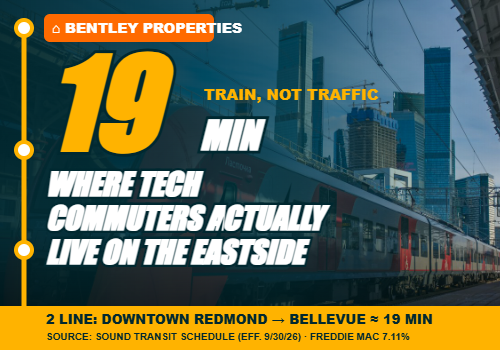
- One schedule summary based on Sound Transit's timetable (valid September 30, 2026 through March 26, 2027) puts Downtown Redmond to Bellevue Downtown at about 19 minutes and Downtown Redmond to Westlake in Seattle at about 41 minutes, not counting walking or waiting.
- Bellevue Downtown to Westlake runs roughly 25 to 28 minutes. Amazon's David Zapolsky described downtown Seattle to downtown Bellevue as about 30 minutes at the opening.
- The adult fare is a flat $3.00 with an ORCA card, according to downtownbellevue.com. Check Sound Transit's trip planner before you plan around any of these numbers.
Two practical notes. First, rail helps most if both ends of your trip are near stations. A home a mile from a station and an office a mile from the other end is a very different trip than one with a short walk on each side. Second, the stations are in the Redmond, Overlake, Spring District and downtown Bellevue areas. Kirkland, Sammamish and Issaquah are not on the line, so those commutes are still car or bus trips for now.
Price points by area
Here are the most recent figures I could verify, with the source and period for each. Different sources define "median" and the time window differently, so read these as ballparks, not a ranking:
- Redmond: a city-wide median of about $1.19 million for the three months through September 2026, down 8.1% from a year earlier (Redfin, as summarized by an Eastside brokerage guide checked October 19, 2026). NWMLS data for the Redmond/Carnation area showed a $1,184,000 house median in September, from 49 sales.
- Bellevue: about $1.50 million city-wide over the same three months, down 1.4% (Redfin). East of I-405, a local market update citing NWMLS put the October single-family median at $1,525,000, down 5.9% from October 2025, with the condo median at $505,000. Bellevue's west side has far fewer sales, so its medians jump around.
- Kirkland: about $1.22 million across all home types for the three months through September (Redfin). Townhomes are a lower-priced slice: a $1,137,499 median across 162 closed sales from November 2025 to November 2026, per NWMLS data on RexMont's site, with 77 of those being new construction.
- Bothell: a 98011 ZIP median of about $995,000 as of November 2026 (NWMLS via RexMont). Active-listing medians in October were roughly $1.3 million for single-family, $825,000 for townhouses and $418,000 for condos. Those are asking prices, not sale prices.
- Issaquah: November 2026 active-listing medians were about $1.4 million for single-family, $850,000 for townhouses and $425,000 for condos (RexMont, RentCast data). Again, asking prices.
For context, the King County median for houses and condos combined was $850,000 in September, from 1,714 closed sales, so the Eastside job-center cities sit well above the county as a whole.
Housing types: what each commute tends to look like
Because the median swings so much by property type, it helps to think in three buckets:
- Condos and apartments near stations. Downtown Bellevue, the Spring District, Overlake and downtown Redmond have the most walkable access to the train and to restaurants and services. Condo medians run well below single-family, such as that $505,000 figure east of I-405 in Bellevue, but HOA dues and building rules are part of the monthly cost.
- Townhomes. This is the middle ground in Kirkland, Bothell, Issaquah and parts of Redmond: more space than a condo, usually a smaller yard or none, and often newer construction. I wrote about the trade-offs in my townhome vs. condo vs. single-family post if you want the cost details.
- Single-family homes. More room and yard, typically farther from stations, and the highest price tags in the job-center cities. Sammamish and Issaquah usually mean more space for the money and a longer, car-based trip to the campuses.
The monthly math matters more than the median
Freddie Mac's survey had the 30-year fixed rate at 7.11% on November 12, 2026, down from 7.18% the week before and up from 6.24% a year ago. At that rate, a $1.2 million purchase and a $900,000 purchase carry very different principal-and-interest payments before taxes, insurance and HOA dues. It's worth pricing your commute alongside your payment. A shorter commute that costs more each month isn't automatically better, and a lower price farther out has its own costs in time, fuel and parking.
How I'd narrow it down
If you're deciding where to start looking, I'd do this:
- Pick your anchor point (Redmond, downtown Bellevue or Kirkland) and how many days a week you really go in.
- Test the actual drive at the hour you'd really travel, not the average. Try it on a Tuesday and a Thursday.
- If rail is part of the plan, measure the door-to-door trip from a specific address, including the walk, and check the current schedule.
- Set a monthly payment you're comfortable with first, then see which areas and housing types fit.
- Consider where the amenities you use daily are: groceries, trails, gyms, restaurants and parks.
No single area is right for everyone. The right fit depends on your commute, your budget, the housing type you want and the day-to-day amenities you care about.
This post is general market information, not tax, legal or financial advice, and figures can change. Drive times are estimates and prices vary by home. If you'd like to talk through a commute and budget for your situation, reach out anytime to set up a quick call.
Sources (pulled November 18, 2026)
Freddie Mac Primary Mortgage Market Survey (Nov 12, 2026); GeekWire, 2 Line opening coverage (March 2026); downtownbellevue.com, Bellevue to Seattle Light Rail guide (Nov 2026); Sound Transit 2 Line schedule information; RexMont Eastside Commute Guide (May 2026); Popach & Co. Bellevue Housing Market Update (Oct 2026, citing NWMLS, Redfin and Zillow); Odigo Tech Package Microsoft Eastside Relocation Playbook (checked Oct 19, 2026, citing Redfin and NWMLS); RexMont Kirkland townhome, Bothell and Issaquah market pages (Nov 2026); KUOW, Google in Washington (April 21, 2022).