Moving to the Eastside from Denver or Chicago: What to Know First
If you're in Denver or Chicago and the Eastside has landed on your list, the first thing worth knowing is that this isn't a like-for-like swap. The sticker price is different, the tax structure is different, and the order you do things in matters more when you're moving across the country. Here's what I'd want you to know before you book a single flight.
Start with the rate, because everything else flows from it
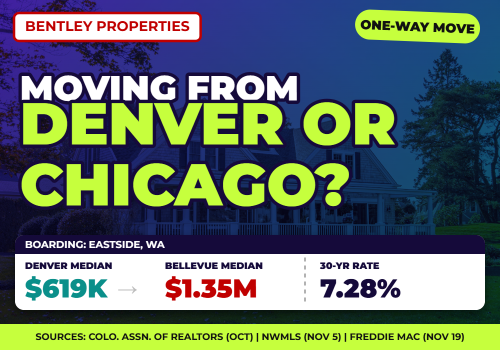
Freddie Mac's weekly survey put the 30-year fixed at 7.28% on November 19, up from 7.11% the week before. A year earlier it was 6.26%. Rates move weekly and your own quote will depend on your lender and your file, but 7.28% is the backdrop for every payment figure below.
What home prices look like in each place
These are not perfectly matched numbers, because each source measures a little differently, so treat them as a rough picture rather than a scoreboard.
Denver: The Colorado Association of Realtors reported a Denver-area median of $619,000 for October, down 0.9% from a year ago. Sales were down about 20%, and concessions showed up in roughly 64% of Denver County sales, so buyers there have had some room to negotiate.
Chicago: Zillow's typical home value for the city was $334,108 as of September 30, up 5.6% over the year, and its median sale price was $388,500 as of the end of August. Redfin data reported by Chicago Agent magazine showed the Chicago-area median sale price up 5.2% year over year in the four weeks ending October 11.
Eastside: Using NWMLS data from the last 90 days, the median sold price in Bellevue was $1,349,000 as of November 5 (down 12.7% from a year earlier, selling at 96.1% of list). Kirkland's was $1,207,500 as of November 20 (down 4.8%, at 97.1% of list).
The plain version: the typical Eastside price is roughly double the Denver median and about three times the Chicago median sale price. That gap is the single biggest adjustment, and it's why many relocating buyers end up looking at townhomes or condos, or at a different city than they first imagined.
What a monthly payment looks like
Here is principal and interest only, assuming 20% down and a 30-year loan at 7.28%. It's arithmetic, not a quote, and it leaves out taxes, insurance and any HOA dues.
- Chicago at $388,500: about $2,127 a month
- Denver at $619,000: about $3,388 a month
- Kirkland at $1,207,500: about $6,609 a month
- Bellevue at $1,349,000: about $7,384 a month
If you're selling a home in Denver or Chicago, the equity you walk away with is what bridges that gap, so it's worth getting a realistic sale estimate before you set an Eastside budget.
Taxes: the Washington surprises
The one most people hear about is that Washington has no tax on wage income. Colorado's income tax is a flat 4.40% and Illinois's is a flat 4.95% (Tax Foundation, 2026), so for a salaried worker that line on the paycheck goes away.
The trade-off is sales tax. Washington's state rate is 6.5%, and with local additions the combined rate is 10.30% in Bellevue and 10.40% in Kirkland and Redmond (Washington Department of Revenue, effective October 1, 2026). Washington also has a capital gains tax that applies to certain high-income investment gains, with a top rate of 9% on gains above $1 million, so if you're selling investments or a business alongside the move, talk to a tax professional before you assume anything.
On property tax, Denver's effective residential rate is estimated at roughly 0.48% to 0.55% of market value (Virtuance, August 2026), and Cook County assesses residential property at 10% of market value before the tax rate is applied; residential bills there rose 5.34% from 2024 to 2025 (Chicago Sun-Times). In King County, rates vary by taxing district, and total 2026 property taxes countywide are about $8.4 billion, up roughly 10% from last year (King County Assessor). I'm not going to quote you a single Eastside percentage, because the right number depends on the exact address. Ask me for the levy on any home you're considering and I'll pull it.
Insurance, heating and cooling
Insurify's November 2026 figures, based on $300,000 of dwelling coverage, average $1,392 a year in Washington, $2,544 in Illinois and $3,120 in Colorado. NerdWallet's May 2026 numbers use a $400,000 dwelling and show $1,880 in Washington, $3,240 in Illinois and $3,910 in Colorado. The two sources use different assumptions, so the dollar amounts don't match, but Washington came in lowest in both. Your real premium depends on the home, its age and your claims history.
I couldn't find a reliable apples-to-apples source for heating and cooling bills, so I won't invent one. What I'd do instead is ask every listing the practical questions: how is it heated, does it have central air, how old are the systems, and what did the owners actually pay last winter and summer. Utility costs vary a lot from one house to the next, and those answers matter more than any regional average.
Commute and daily life
The Eastside's job centers in Bellevue, Redmond and Kirkland are close to each other, which makes your neighborhood choice and your work location a package deal. I can't give you an honest average commute, so my advice is to drive the route you'd actually take at the hour you'd actually take it, on a weekday, before you write an offer. Traffic around the bridges and I-405 is the reality check no spreadsheet gives you.
Timing the sale and the purchase
This is where cross-country moves get stressful. You have a few common paths: sell first and rent for a stretch, buy first and carry two homes briefly, or try to line the two up. Each has trade-offs around cash, stress and how competitive your offer looks. An offer that depends on selling your current home can be less attractive to a seller than one that doesn't, so it's worth talking with a lender about your options early. Given the Denver concessions data above, plan for some negotiation on your sale as well.
Buying from 1,000 miles away
Plenty of people buy here without seeing a home in person first, but I'd do it carefully:
- Ask for a live video walkthrough, not just a polished tour, so you can see the street, the light and the details.
- Hire a local inspector and consider a sewer scope on older homes, since you can't check the basement yourself.
- Read the seller disclosure and the inspection report line by line, and have someone local explain anything unfamiliar.
- Plan one in-person trip at the end, if you can, to walk the home and drive the commute before you remove contingencies.
A simple first-week checklist
Get a realistic sale estimate for your current home, talk to a lender about the rate and the payment you're comfortable with, pick two or three cities to compare rather than one, and decide whether you'd rather sell first or buy first. Once you have those four answers, the rest gets much easier.
This is general information about the market, not legal, tax or financial advice. Please check the specifics with your lender, CPA and attorney.
Reach out anytime to set up a quick call, and we can walk through your numbers and your timeline together.
Sources
Freddie Mac PMMS (Nov 19, 2026); Colorado Association of Realtors via Colorado Sun/HPPR (Nov 17, 2026) and Axios Denver (Nov 12, 2026); Zillow Chicago home values (data through Sept 30, 2026); Chicago Agent citing Redfin (Oct 29, 2026); Beyond Real Estate / NWMLS (Bellevue as of Nov 5, 2026; Kirkland as of Nov 20, 2026); Tax Foundation state income tax rates (2026); Washington Department of Revenue Q4 2026 local sales tax rates; Virtuance Denver property tax (Aug 2026); Chicago Sun-Times (Aug 24, 2026); King County Assessor 2026 taxes; Insurify (Nov 17, 2026); NerdWallet (May 6, 2026). Payment figures are the author's arithmetic.